Ma
For Whom the Bell TollsHorses are indispensable to the guerrillas’ mobility and survival, but they are not merely equipment: the novel gives them physical needs, fear, and responses to human handling. Their roles shift from carefully tended mounts in Pablo’s camp to frightened companions during an attack and casualties in El Sordo’s last fight. Set beside the characters’ different attitudes toward killing, these scenes make the cost of military necessity visible across the boundary between human and animal life.
The herd in Pablo’s camp
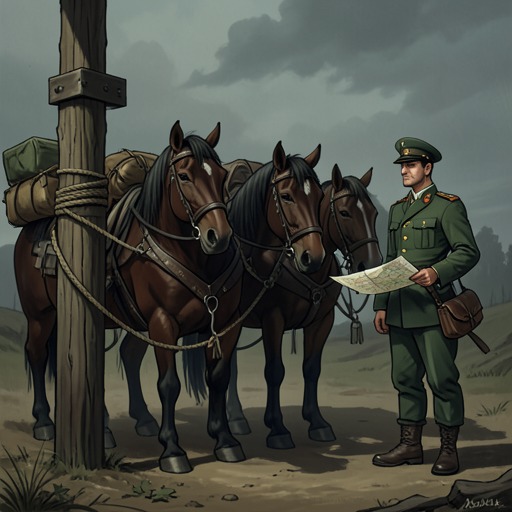
The guerrillas’ horses are kept out of sight in the timber by day and allowed to graze in a clearing at night. Robert Jordan reads the evidence of their care and use in the cropped grass, picket-pin marks, a trail to the stream, and fresh manure. Farther on, a rope corral runs around the tree trunks; the horses stand inside, while saddles are stacked beneath a tarpaulin outside. The practical arrangements mark the animals as a guarded resource, but the scene also presents them as a living herd occupying its own space in the forest.
There are five horses in the corral: three bays, a sorrel, and a buckskin. Robert Jordan looks them over individually and tells Pablo that they are beautiful, recognizing the importance of the animals to the band’s cavalry. Pablo, who has been gloomy, watches them with pride and says that he has taken them all. The herd briefly restores a different expression to him: his relationship with the horses is one of the few subjects in these scenes that draws out his evident affection and satisfaction.
The animals also reveal the contrast between Pablo’s attachment and his despair. Looking at the strong horses, he says that the enemy is stronger and better armed and that he sees no future beyond being hunted and dying. The horses are a real achievement, but their strength cannot answer his fear about the larger military situation. They embody both the resources he has secured and the limits of what those resources can accomplish.
Care, speech, and different kinds of killing
At night, Robert Jordan sees Pablo standing beside the big bay stallion, moving with the horse as it shifts at the end of its picket rope and patting its neck. Pablo is neither unsaddling nor preparing to take the horse away. He speaks to it in private endearments, comparing its arched neck with the viaduct in his village and distinguishing its reliable presence from human relationships that have brought him pain. The horse does not understand the words; it continues to graze, impatient with the interruption. The scene holds Pablo’s tenderness and the animal’s separate, immediate concerns together without pretending that they are the same.
Elsewhere, Anselmo explains that he loves hunting and that people in his village hunt, while Robert Jordan says that he does not like killing animals. Anselmo makes the contrast explicit: he does not like killing men. Robert Jordan answers that people do not normally like it, but that killing can be necessary for the cause. Their exchange distinguishes the act of killing an animal for the hunt from killing a person in war, without making either man’s position a simple rule for every circumstance.
Anselmo recalls taking pride in the memory of a bear hunt, including the bear’s paw nailed to a church door. That pleasure, he says, does not extend to killing a man: nothing good remains from killing someone who is a man like oneself. Robert Jordan points out that a human hand cannot be nailed to a church in the same way; Anselmo responds that the hand of a man is like the paw of a bear. The comparison brings animal and human bodies into uneasy proximity, even as Anselmo insists on the moral difference he feels between hunting and wartime killing.
Horses amid watch and movement
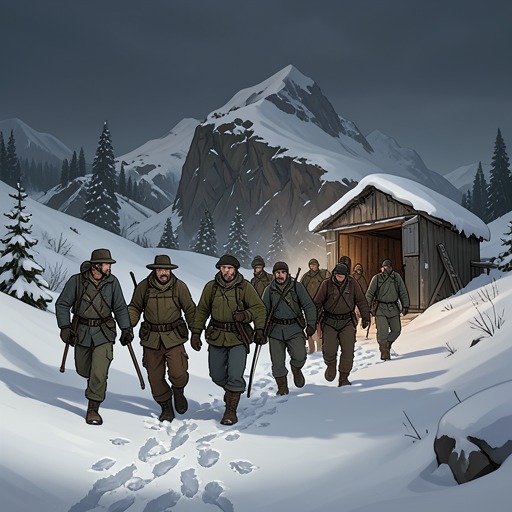
During a snowy watch near the sawmill, Anselmo thinks about the men inside, whom he has observed throughout the day. He regards them as poor men like himself, separated from the guerrillas by orders and the threat to their families, and finds it painful to contemplate killing them. His reflections take place while he waits in the cold for Robert Jordan, under orders to remain at his post. The contrast between the men’s shelter and the guerrillas’ exposed position belongs to a landscape where human movement, military duty, and animal mobility are all constrained by the conditions of the war.
Horses are also present in the practical arrangements of camp. When Pilar tells Pablo to go down and count his animals, the instruction treats the herd as something whose number and whereabouts matter to the group. The reference is matter-of-fact, but it reinforces their place in the band’s daily security: the animals must be accounted for, and a horse may be offered when the group considers how Robert Jordan or Maria might travel.
Combat, injury, and the limits of control
During El Sordo’s last fight, horses become part of the effort to reach and hold a hilltop. El Sordo rides toward the crest carrying his automatic rifle and ammunition, while Joaquín and Ignacio stop to fire and give him time to get the gun in place. Snow has already worsened their position. When El Sordo’s horse is hit and struggles up the final stretch, he leads it by the bridle while climbing under fire. At the top, he shoots the horse quickly and uses its fallen body to block a gap between rocks, then fires the automatic rifle from over its back. A mount, companion, and tactical barrier are joined in a single grim consequence of the fight.
The losses extend beyond that one animal. Two other horses lie dead along the slope and three more on the hilltop. The group had stolen only three horses the previous night; one bolted when they tried to mount it bareback after shooting began at camp. The sequence counters any assumption that horses can simply be acquired and directed as military resources. They may be lost to gunfire, exhausted in flight, or frightened beyond control, and each failure of control further narrows the guerrillas’ options.
The attack and the animals’ fear
During the bridge operation, Maria waits in the forest with the horses, unable to see either the road or the bridge. When firing and bombing begin, she puts an arm around the neck of the big white-faced bay stallion, which she has gentled and brought gifts to during its time in the corral. The animal is nervous at the noise and jerks its head; her own agitation makes it more nervous, and as she walks among the horses, patting and trying to soothe them, the whole group grows more unsettled.
Maria tries to understand the sounds as part of the operation and to trust that Robert Jordan is safe, while gunfire from both sides of the bridge and the distant battle overwhelm that effort. The horses cannot see the action either, but they register it through noise and human movement. Their agitation is not a symbol detached from the scene: it changes the immediate task of tending them and shows how combat reaches beings kept away from the fighting.
Across these episodes, the horses’ value to the guerrillas never cancels their vulnerability. The corral and saddles show care organized around military use; Pablo’s private tenderness, Maria’s attention to the stallion, and the animals’ own fear complicate that utility. El Sordo’s horse, killed because the fight leaves no other practical choice, returns the novel to the ethical tension voiced by Anselmo and Robert Jordan: necessity may govern wartime action, but it does not make the lives caught within it inconsequential.